Table of Contents
- What Is a Free Zone Company Bank Account?
- Why Your Free Zone Company Needs a Business Bank Account
- Requirements to Open a Bank Account for a Free Zone Company
- Types of Business Accounts You Can Choose
- How to Open a Business Bank Account: Step-by-Step Guide
- Best Banks for UAE Free Zone Companies
- Can You Complete the Process Online?
- Why Applications Get Rejected
- How Long Does Approval Take?
- What We Tell Clients Before They Apply
- How Global Business Services FZCO Can Help
- Conclusion
- FAQs
Your trade license arrives, your company exists on paper, and then you hit the part nobody informed you about. UAE banks must carry out customer due diligence before opening a corporate account. The depth and timing of that review depend on the bank’s policies, your business activity, ownership structure, expected transactions, and the evidence you provide.
The good news is that opening a business bank account in the UAE is fairly straightforward when you know what the bank expects. Compliance teams mainly want to understand your business, where your money comes from, and whether your documents are complete and consistent. In this guide, we explain what you need to open a business bank account in the UAE, including the required documents, banks you can consider, typical processing times, and common mistakes that can delay or lead to a rejected application.
What Is a Free Zone Company Bank Account?
A company bank account in the UAE is a corporate account held in your company’s name rather than yours. Your trade license, your shareholders, and your business activity all sit behind it. Money you receive from clients lands there, and your suppliers get paid from there.
A free zone company normally applies for a standard UAE corporate account. Each bank sets its own eligibility criteria and risk assessment, which may consider the company’s license, activity, ownership structure, operating presence, expected transactions, counterparties, and supporting evidence.
Does Your Free Zone Choice Affect Approval?
It does, and more than people expect. Banks may have different onboarding criteria for companies licensed by different authorities. Before incorporating, confirm directly with your preferred banks whether they accept your proposed license, activity, ownership structure, and operating model. Do not rely on a free zone’s price or reputation as a predictor of approval.
This matters when you select your jurisdiction. If banking is a priority, weigh that against setup cost before you register. Our guide to affordable free zones in the UAE covers which low-cost options still hold up well with banks.
Why Your Free Zone Company Needs a Business Bank Account
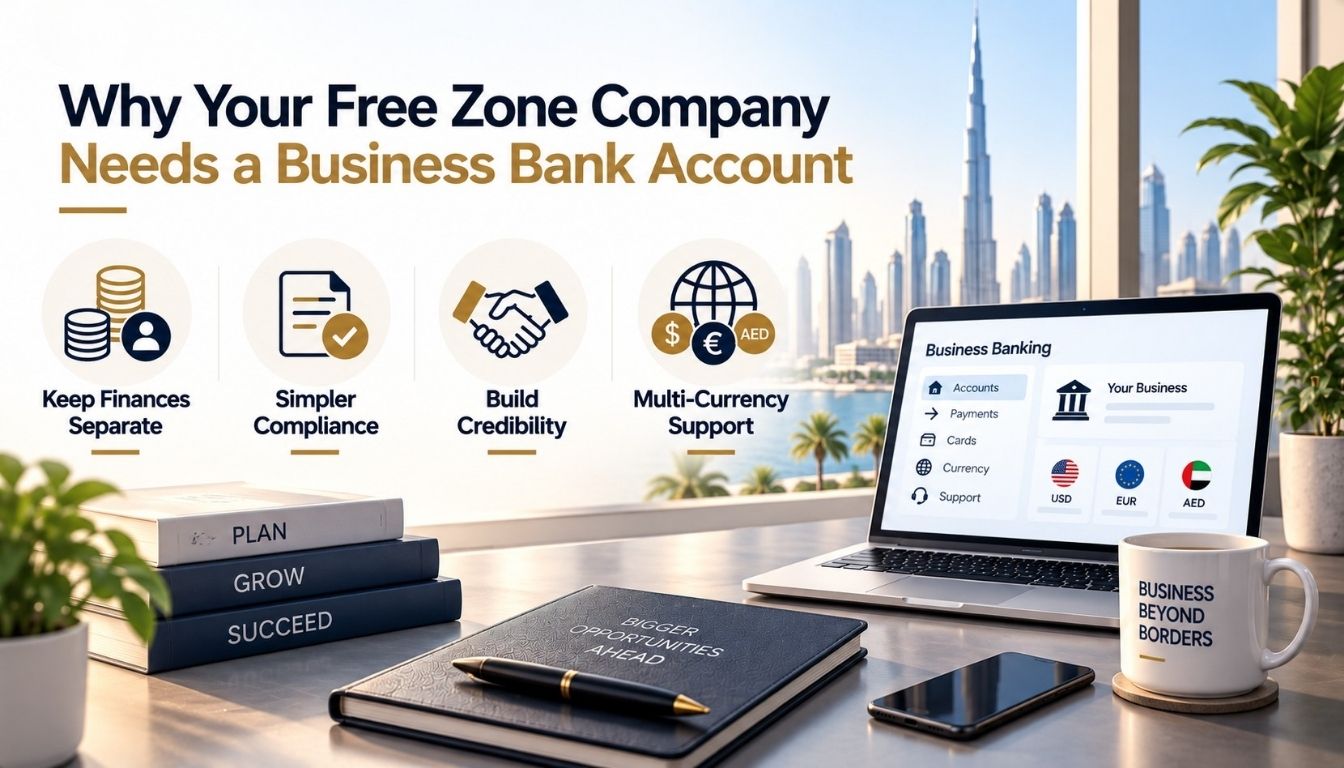
A dedicated corporate account helps keep company and personal transactions separate, improves record-keeping, and makes accounting, tax, audit, and compliance processes easier to manage. Always check your bank’s account terms before using any account for business activity.
A proper corporate account does a few things for you:
- Separates your money from the company’s money: Corporate tax filing and VAT returns become straightforward when the records are already clean.
- Makes you credible to clients: Corporate buyers pay invoices to company accounts. Some will not release payment to an individual account.
- Opens the door to credit: Trade finance, business credit cards, and working capital lines all start with an account history at that bank.
- Handles multiple currencies: If you invoice in dollars, euros, and dirhams, a multi-currency account saves you conversion losses on every transaction.
Requirements to Open a Bank Account for a Free Zone Company
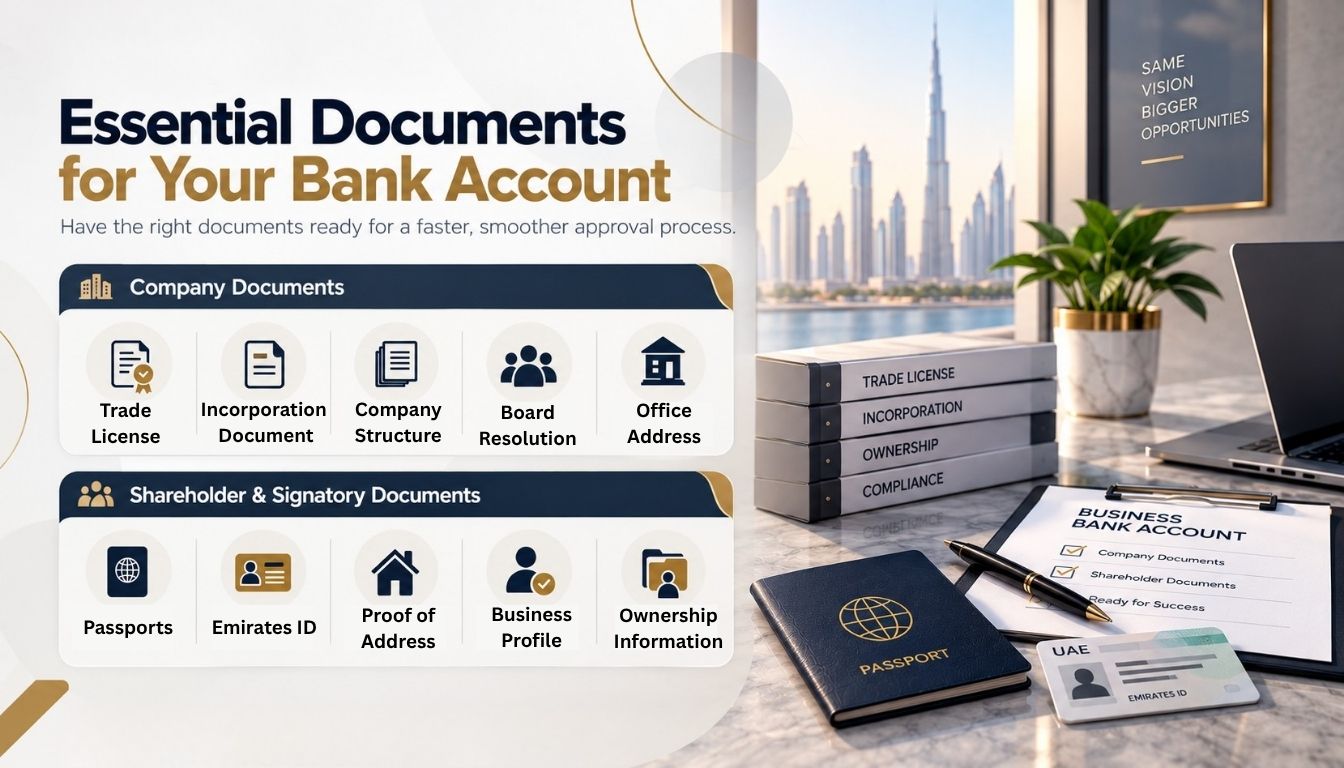
The requirements to open a new bank account are consistent across most UAE banks, though each one adds its own preferences. Get the core set right and you avoid the back-and-forth that stretches applications into a second month.
Company Documents
- Valid trade license from your free zone authority
- Certificate of incorporation or formation
- Memorandum and Articles of Association
- Share certificates showing ownership split
- Board resolution approving the account opening and naming signatories
- Lease agreement, Ejari, or flexi-desk agreement from the free zone
Shareholder and Signatory Documents
- Passport copies for every shareholder and director
- Passport and identification documents for shareholders, directors, authorised signatories, and ultimate beneficial owners, as required by the bank
- UAE residence visa and Emirates ID where applicable or requested by the bank
- Proof of residential address, where requested
- A CV, professional profile, or evidence of relevant business experience where requested
- Ultimate beneficial ownership information and supporting ownership documents
What Banks Ask For Beyond the Checklist
If you are wondering what you need to open a bank account beyond the standard paperwork, this is where applications live or die. Compliance teams want to see a real business, and they judge that from supporting evidence.
Prepare a short business profile explaining what you sell and to whom. Name three suppliers and three customers. Bring signed contracts, invoices, or purchase orders if you have them. Be ready to provide bank statements, evidence of source of funds or source of wealth, and a realistic forecast of expected account activity if requested. The required period and documents vary by bank and customer risk profile.
Applicants who show up with contracts and a clear story get approved.
Types of Business Accounts You Can Choose

The account types and facilities available to a free zone company vary by bank, legal structure, business activity, and eligibility. Common options may include AED current accounts, foreign-currency accounts, savings or deposit products, payment cards, cheque facilities, trade services, and financing. Confirm availability, pricing, and eligibility directly with the bank.
| Account Type | Best For | Key Features |
| Current account | Daily operations | Cheque book, debit card, salary payments, no interest |
| Multi-currency account | Import, export, international clients | Hold AED, USD, EUR, GBP in one account |
| Call or savings account | Idle cash | Earns interest, limited transactions |
| Fixed deposit | Reserves you will not touch | Higher interest, locked for a fixed term |
Start with a current account. Add a multi-currency facility if you bill overseas clients, since converting every incoming payment at the bank’s spot rate quietly eats into your margin.
How to Open a Business Bank Account: Step-by-Step Guide
Clients often tell us “I want to open a business bank account” before their license is even issued. That order does not work. Here is the sequence banks expect:
- Complete your company registration first: No bank reviews an application without a trade license. If you are still choosing a jurisdiction, our free zone business setup consultants Dubai can help you.
- Sort out your visa and Emirates ID: Banks set their own requirements for resident and non-resident shareholders and signatories. The majority of banks require a UAE-resident signatory, while others assess applications from non-residents subject to their eligibility and due-diligence requirements.
- Shortlist two or three banks: Compare minimum balance, monthly fees, and how they consider your business activity. Applying to only one bank leaves you restarting from zero if they decline.
- Assemble the full document set: Missing documents are the top cause of delay. Check every expiry date, and confirm names match across your passport, license, and MOA.
- Submit and attend the KYC meeting: Some banks handle this by video call, and others want you at the branch. The relationship manager will ask about your business model, clients, and source of funds.
- Wait through compliance review: The bank runs background checks on shareholders and screens against sanctions lists. Respond fast to any follow-up query, since files that go quiet get deprioritized.
- Fund the account and collect your credentials: Once approved, deposit the minimum balance and set up online banking, your cheque book, and cards.
Best Banks for UAE Free Zone Companies
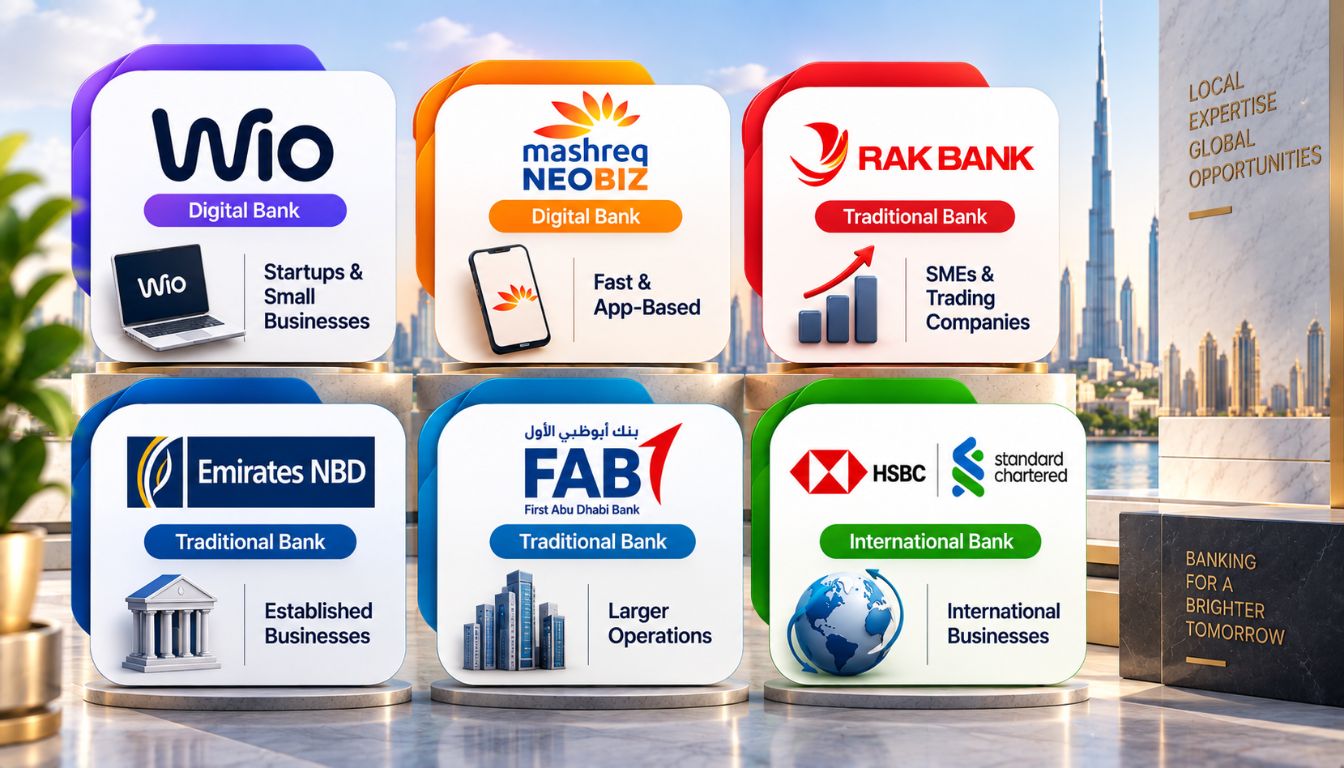
No single bank suits every business. A trading company moving containers needs different facilities than a two-person consultancy. This table covers the options we recommend most often:
| Bank | Type | Suits |
| Wio Bank | Digital | Startups, small free zone companies, digital-first owners |
| Mashreq NeoBiz | Digital | New businesses wanting fast app-based onboarding |
| RAKBANK | Traditional | SMEs, trading companies, wide branch access |
| Emirates NBD | Traditional | Established companies, strong online platform |
| First Abu Dhabi Bank | Traditional | Larger operations, corporate facilities |
| HSBC or Standard Chartered | International | Companies with international group structures |
Note: Minimum balance requirements, fees, and eligibility rules differ by bank and change often. Banks also adjust them based on your activity, turnover, and risk profile, so confirm the current terms directly before you apply.
Traditional Bank
Emirates NBD, FAB, RAKBANK, and Mashreq give you branches, cheque books, trade finance, and credit facilities. Their compliance reviews run longer, and their minimum balance requirements lock up working capital you may need elsewhere. Fall below the threshold, and they charge a monthly shortfall fee.
Digital Bank
Digital business banking providers can offer online application journeys and app-based account management. However, product features differ: some providers offer cheque books, cards, multi-currency accounts, payment services, financing, or trade-related facilities. Check the current terms, fees, availability, and eligibility before applying.
For most new consultancies, agencies, and e-commerce sellers, a digital bank covers everything they actually use. If you are opening a business bank account for new business activity with no trading history yet, this is usually the shortest route to approval.
Can You Complete the Process Online?
UAE free zone business bank account opening online works well with digital banks. You upload your documents through the app, hop on a video call for verification, and that is it. Some banks offer online application and digital verification journeys. An account is opened only after the bank completes its required due diligence, and processing times vary by bank, application complexity, and the information provided.
Traditional and digital banks may offer online application journeys, but they can request a video call, digital verification, additional documents, or an in-person meeting depending on their policies and risk assessment. The CBUAE permits digital customer verification where the relevant requirements are met, so do not assume that an in-person meeting is always required. Confirm the process with the specific bank before applying.
Why Applications Get Rejected
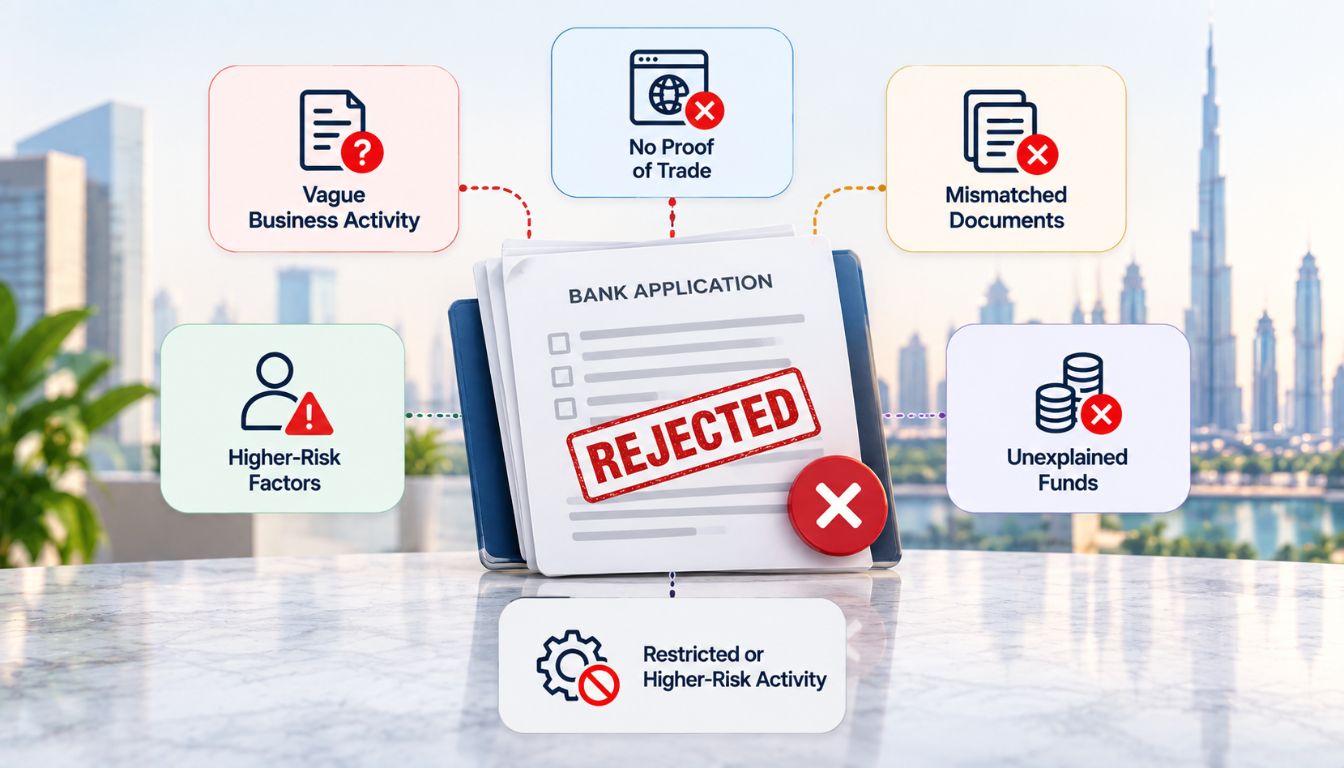
Rejections rarely come with a detailed reason, which makes them frustrating. From the files we have handled, the causes repeat:
- Vague business activity: “General trading” with no detailed information reads as a shell company to a compliance officer.
- No proof of trade: Zero contracts, zero invoices, zero website. Nothing shows the business is real.
- Mismatched documents: Your name is spelled differently on the passport and the license, or the MOA lists an old shareholder.
- Higher-risk factors: A bank may apply enhanced due diligence where its risk assessment identifies relevant factors, such as sanctions exposure, politically exposed person status, complex ownership, higher-risk jurisdictions, unusual transaction patterns, or insufficiently evidenced source of funds or wealth.
- Unexplained personal funds: A large deposit appears in your statements with no story attached.
- Restricted or higher-risk activity: Some banks may not onboard, or may apply enhanced scrutiny to, businesses in sectors such as virtual assets, precious metals, defence-related trade, remittance, money services, or cash-intensive activity. Acceptance depends on the bank’s policy, regulatory permissions, and the company’s compliance evidence.
Fix what you can before applying. A simple website, two signed client contracts, and a one-page business profile move an application from doubtful to approved more often than anything else.
How Long Does Approval Take?
There is no universal approval timeline. Digital applications can be faster for eligible, straightforward cases, while applications involving complex ownership, non-resident parties, regulated activities, international transactions, or further due diligence can take longer. Ask each bank for its current indicative timeline, but do not treat it as a guarantee.
Those timelines assume complete documents and quick responses on your side. Every unanswered query adds a week. Companies with non-resident shareholders and no UAE-based signatory sit at the slow end of every range.
What We Tell Clients Before They Apply
A few things we repeat in almost every consultation:
- Apply to two banks at once: If one declines, you have not lost a month.
- Build a paper trail before you apply: Register a domain, set up a company email, sign one client. Cost is minimal, and the credibility gain is large.
- Match your turnover claim to reality: Inflate your first-year projection and the bank will ask how you plan to get there. Give a number you can defend.
- Answer the source of funds question in writing: Salary savings, a property sale, a business exit. Name it and attach evidence.
- Use clear and consistent contact details: A company-domain email can strengthen your professional presentation, but it does not replace the documents and evidence required by the bank.
- Keep your license current: An expired trade license kills the application on day one.
Note: Information in this guide is provided for general guidance only. Business banking eligibility, required documents, fees, minimum-balance requirements, products, and processing times vary by bank and may change without notice. Final approval is always subject to the bank’s internal policies and due-diligence checks. Confirm the latest terms directly with your chosen bank before applying.
How Global Business Services FZCO Can Help
Most rejections come from a preparation gap rather than anything wrong with the business. As company setup consultants UAE businesses rely on, we review your file before it reaches a bank, flag the weak points, and introduce you to institutions that already work with companies like yours.
We also handle the sequence properly, because company bank account opening goes faster when your license, visa, and Emirates ID land in the right order. Clients who come to us after two rejections usually need a rebuilt file rather than a new bank. Contact us and send your documents to info@gbsei.com or call +971 4 4471804, and we will tell you where the gaps are before a bank finds them.
- 50+ Team Members ready to handle your A-Z paperwork.
- 7,500+ Happy Customers successfully established.
- 30+ Years of Experience navigating UAE laws.
Conclusion
UAE banks are careful, but they are not out to reject you. They want a real business, a clear activity, an owner who can explain where the money came from, and documents that agree with each other. Give the bank clear, consistent, and well-supported information, and you improve the quality of your application. Approval remains subject to the bank’s due-diligence process, internal policy, and final decision.
If you want someone to check your documents before they go in, send them over to us at Global Business Services FZCO. We will review them and tell you what is missing.
FAQs
What do you need to open a bank account for a free zone company?
You need a valid trade license, certificate of incorporation, MOA, share certificates, a board resolution, passport copies for all shareholders, Emirates ID and visa for signatories, proof of address, and a business profile. Most banks also ask for contracts, invoices, and six months of personal bank statements.
Can I open a business bank account without a UAE residence visa?
Yes, though your options shrink and the review takes longer. Banks that accept non-resident signatories usually ask for a higher minimum balance and more evidence of your source of funds. Getting an investor visa for one shareholder removes most of the friction.
How much money do I need to keep in the account?
Every bank sets its own minimum balance, so the amount varies. Digital banks sit at the low end, local banks in the middle, and international banks ask for the most. Drop below your bank’s threshold, and they charge a monthly shortfall fee, so check the current requirement before you choose.
Which bank is easiest for a new free zone company?
Wio Business and Mashreq NeoBiz offer digital business banking options, but eligibility, fees, account features, balance requirements, and processing times can change. Compare the current terms and confirm whether your free zone company and business activity qualify before applying. If you need trade finance or cheque facilities, RAKBANK handles SMEs well.
Can I open the account before my company is registered?
No. The trade license is the first document every bank asks for. Registration comes first, then your visa and Emirates ID, then the account.
Why do banks reject free zone company applications?
The usual causes are a vague business activity, no proof of actual trading, mismatched documents, a high-risk nationality or industry, and unexplained deposits in personal statements. Preparing a clear business profile with supporting contracts fixes most of these.
Do I need to be in the UAE to open the account?
The need to be in the UAE depends on the bank, account type, applicant profile, and verification method. Some banks support digital onboarding, while others may require a video call or in-person meeting. Confirm the current process with the bank before making travel arrangements.
Can a free zone company open an account with any UAE bank?
In theory, yes; in practice, no. Each bank keeps its own view on which free zones and which activities it will accept. This is why applying to two banks at once saves time.
Can I open a business bank account after company formation in Rakez or another UAE free zone?
Yes. After completing company formation in Rakez or setting up a company in another UAE free zone and receiving your valid trade license and incorporation documents, you can apply for a UAE corporate bank account. The bank will assess your business activity, ownership structure, source of funds, and supporting documents before making a final decision. Prepare complete and consistent company documents to help make the account-opening process smoother.